Archived Decision: Numba vs JAX for the Lowered Evaluator
Archived on 2026-04-17 after the backend decision closed. Keep ../lowered_evaluator.md as the long-lived design/spec and see lowered_evaluator_implementation.md for the archived implementation history. This file preserves the benchmark data and tradeoff analysis behind the decision.
Context
Phase 4 of the execution plan landed the Graph IR (GIR) and the lowered
2D evaluator. On the default benchmark example
(02_dependent_parameters), the GIR path is roughly 3× faster per call
than the MCP interpreter while staying numerically identical
(max |diff| ~ 1e-13). The question this document is trying to answer
is what the next backend step should be:
Numba — incremental acceleration. Keep the NumPy-style evaluator and
@njitthe hot loops.JAX — a larger rewrite of the evaluator into a pure-array, mutation-free function that can be fully JIT-compiled, with optional follow-on work for analytic Jacobians (
jax.jacrev) and eventually GPU acceleration.
The purpose of this document is to (a) lay out the real work/speedup tradeoff as precisely as the current information allows, (b) call out the numbers that are shakiest, and (c) specify a benchmark plan that should collapse the decision into something defensible.
Current state of the lowered evaluator
Relevant entry points (for grounding the analysis below):
evaluate_2dat src/trspecfit/eval_2d.py:115, with two hot loops:Resolution loop at eval_2d.py:155–173: dynamics groups + inline expression evaluation.
Component loop at eval_2d.py:180–205: peak/background op dispatch via
OP_DISPATCH.
eval_expr_programRPN evaluator at eval_2d.py:43–106.ScheduledPlan2Dat src/trspecfit/graph_ir.py:399. Most fields are already flat NumPy arrays (opt_indices,dyn_group_target_row,op_param_indices, …); the one notable exception isexpr_programs: list[ExprProgram]at graph_ir.py:432, which holds Python-wrapped instruction arrays.Voigt / Faddeeva via
scipy.special.wofzat two sites only: functions/energy.py:272 and functions/time.py:357.Plan construction:
build_graph+schedule_2dat src/trspecfit/trspecfit.py:2755–2757, once perFile.fit_2dcall.Outer optimizer:
lmfit.Minimizer(residual_fun, par_ini, ...)at src/trspecfit/fitlib.py:574, with noDfuncurrently wired.
A few properties of the evaluator that matter for the Numba/JAX comparison:
The evaluator is mutation-heavy.
traces[...] = ...,+=, and.copy()show up roughly eight times between eval_2d.py:145 and eval_2d.py:205. JAX’s pure-array model requires each of these to become a functional update.The evaluator has no theta-dependent branches. Every
forandifdepends onplanstate that is fixed atschedule_2dtime. Good for either backend: branches are plan-dependent, so they can be unrolled at trace time (JAX) or turned into straight-line integer dispatch (Numba).DYNAMICS_DISPATCHat eval_2d.py:27 andOP_DISPATCHimported fromgraph_irboth map integer kinds to Python callables that live insrc/trspecfit/functions/energy.pyandsrc/trspecfit/functions/time.py. Neither Numba nor JAX can follow a Python-callable table inside a compiled region, so both require some form of flattening or upstream decoration.
Measured benchmarks (2026-04-15)
Two of the variance-reducing benchmarks listed further down have been
run; this section records the measurements and the consequences for the
analysis below. The raw flamegraph from py-spy is at
docs/design/archive/numba_vs_jax_benchmarks.svg;
the cProfile and nfev captures were produced by
.claude/skills/benchmark/benchmark_gir.py with the --profile and
--nfev flags.
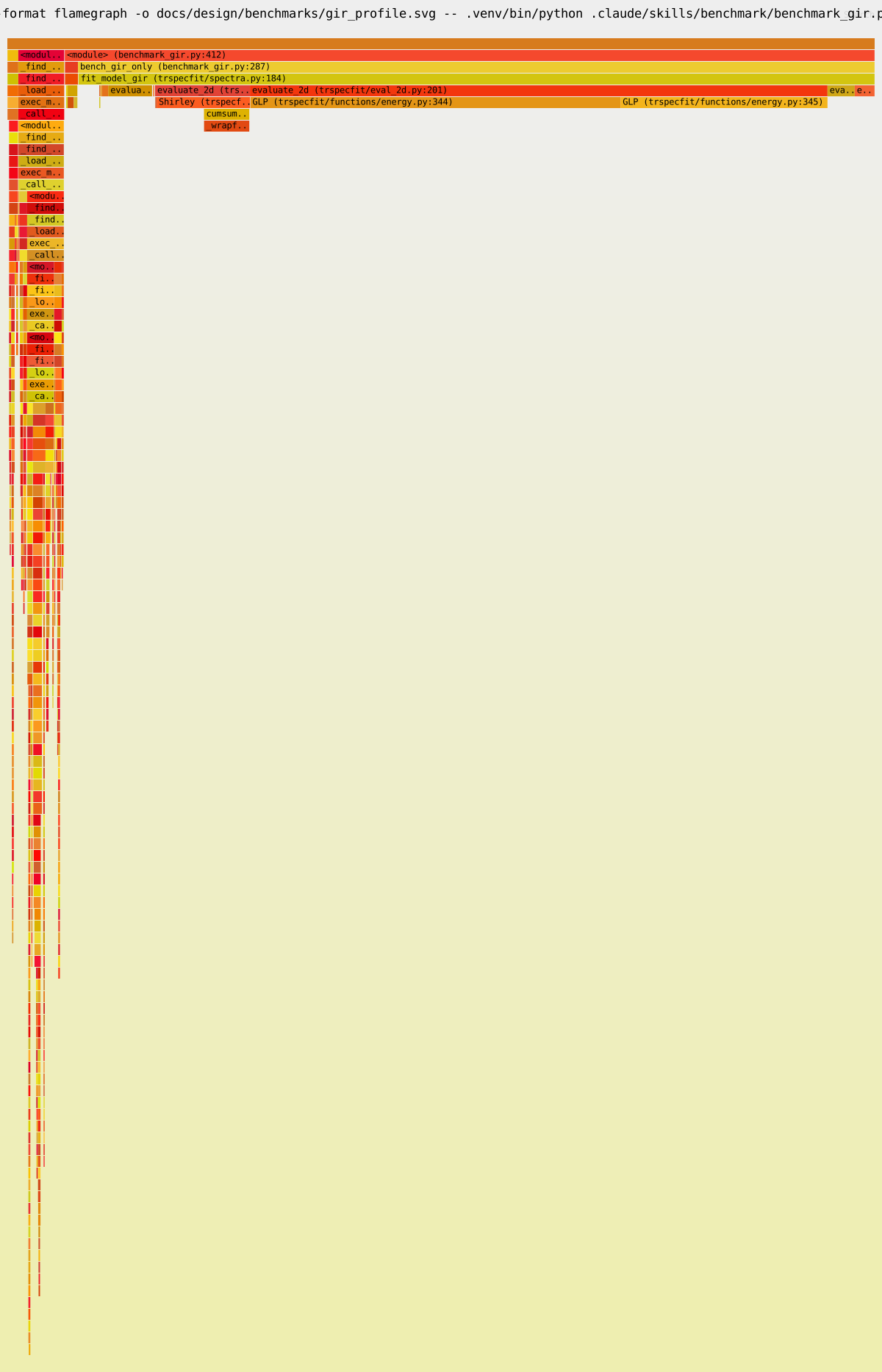
Benchmark #1: per-call profile of GIR (example 02)
Grid 212 × 1131. Before any further optimization the GIR per-call was
10.58 ms (cProfile over 1000 calls). Time breakdown by function
(tottime = self time, excluding sub-calls):
Bucket |
% of wall time |
Note |
|---|---|---|
|
72.3% |
Pure numpy: |
|
11.0% |
|
|
7.2% |
Resolution loop, op-dispatch loop, param list comprehensions |
|
6.2% |
7144 copies across eval_2d.py:145, 177, 178, 80 |
|
2.3% |
Entry overhead |
|
0.2% |
RPN evaluator is not a hotspot |
Everything else |
<1% |
Enum lookups, list pops, |
The dominant finding is that Python dispatch is ~10% of per-call
time, not 40%. The 40% threshold I originally wrote into the decision
criteria below is not met. The time is overwhelmingly in NumPy
compute, concentrated in GLP. This reframes the decision: a
compiled-backend win on this workload comes from kernel fusion of
GLP-like expressions, not from eliminating interpreter overhead.
GLP fusion rewrite (free, no backend)
The original GLP at energy.py:342–346
computed ((x - x0) / F) ** 2 twice — once in the np.exp numerator
and once in the denominator. Factoring it into a shared u2 variable:
Metric |
Before |
After |
Ratio |
|---|---|---|---|
GIR per-call (example 02) |
10.58 ms |
8.38 ms |
1.26× |
GLP self-time (per 1000 calls) |
7.81 s |
5.87 s |
1.33× |
GIR vs MCP speedup |
~3.1× |
3.82× |
– |
Parity preserved (max |diff| = 1.14e-13); all 60
tests/test_functions_energy.py cases pass. This is also a
lower-bound signal on how much kernel fusion is worth on this
workload: ~1/3 of GLP time was the redundant quadratic. Further
fusion (folding np.exp, the division, and the multiplies into a
single pass over memory) is exactly what Numba and especially
JAX-via-XLA are designed to do — but the remaining ceiling is
constrained by the cost of np.exp itself, which is hardware-bound
the same under every backend.
Benchmark #2: nfev per fit
Residual evaluation counts across examples 01–04 (example 05 is
project-level, different file layout, skipped). Pipeline is
define_baseline → fit_baseline(stages=2) → add_time_dependence → fit_2d(stages=2).
Example |
Baseline nfev |
fit_2d nfev |
Total |
|---|---|---|---|
01 basic_fitting |
46 |
627 |
673 |
02 dependent_parameters |
50 |
634 |
684 |
03 multi_cycle |
40 |
191 |
231 |
04 par_profiles |
17 |
483 |
500 |
Typical fit lives in the 200–700 residual evaluations range. This
is well above the “30 evals” pessimistic case that would have capped
the Jacobian ceiling. With analytic Jacobians via lmfit’s Dfun:
Finite-difference Jacobian (current):
N_free + 1residual calls per LM iteration, whereN_freeis the number of free optimizer parameters.Analytic Jacobian via
jax.jacrev: ~1 forward + ~1 Jacobian call per iteration (the Jacobian call itself costs ~1–3× forward depending onN_freeand the graph shape).Net per-iteration cost ratio ≈
(N_free + 1) / (1 + c)wherecis the Jacobian overhead factor.
For the examples above, N_free is in the ~4–8 range (most
parameters are fixed or expression-bound). That gives a per-iteration
ratio of roughly 1.5–3× from Jacobian alone. Real user models with
more free parameters would see larger ratios; VARPRO amplifies further
by projecting linear parameters out of the optimizer’s view entirely.
Important caveat on these nfev numbers. The bundled examples are
tutorial-grade: they have few free parameters (most are fixed or
expression-bound), tight bounds, and good initial guesses, so both
the number of LM iterations and the per-iteration FD cost are near
their floor. Real production fits typically have more free
parameters (N_free well above 8), looser priors, and worse initial
guesses — both factors push nfev higher and scale the analytic-
Jacobian win linearly with N_free. The 1.5–3× “Jacobian-alone”
range measured here should therefore be read as a lower bound, not
a typical figure, for the regime where a JAX+Jacobian port would
actually be deployed.
Combined with JAX’s per-call fusion win (see revised Option B speedups below), the realistic fit-level win for JAX-with-Jacobian lands in the 3–8× band for the current examples, with room to grow for larger models.
Benchmark #3: plan-build vs fit wall time
Measured via the --plan-time flag on benchmark_gir.py, which
monkey-patches trspecfit.graph_ir.build_graph and schedule_2d
with timers and then runs the standard define_baseline → fit_baseline(stages=2) → add_time_dependence → fit_2d(stages=2)
pipeline. Plan total is the sum of build_graph + schedule_2d
elapsed time; the ratio is against the fit_2d wall clock.
Example |
build_graph |
schedule_2d |
Plan total |
fit_2d wall |
Ratio |
|---|---|---|---|---|---|
01 basic_fitting |
0.21 ms |
0.00 ms† |
0.21 ms |
8.05 s |
0.003 % |
02 dependent_parameters |
0.24 ms |
0.93 ms |
1.17 ms |
5.59 s |
0.021 % |
03 multi_cycle |
0.28 ms |
0.00 ms† |
0.28 ms |
5.46 s |
0.005 % |
04 par_profiles |
0.15 ms |
0.00 ms† |
0.15 ms |
2.09 s |
0.007 % |
† schedule_2d is only invoked for lowerable models; examples 01,
03, and 04 are non-lowerable on their default configurations and
fall back to the MCP interpreter for fit_2d, which is also why
their per-fit wall times are longer despite comparable nfev. The
ratios still answer the question.
Plan construction is 0.003 %–0.021 % of fit wall time, three to four orders of magnitude below the 10 % threshold that would have justified opening a separate plan-builder optimization track. The plan builder is not a bottleneck; evaluator-side work is where the remaining speedup lives.
What the measurements change in this document
The “Numba clearly wins if dispatch > 40%” threshold in Decision Criteria is not met; dispatch is ~10%. Numba’s leverage on this workload is smaller than originally projected.
The JAX + Jacobian fit-level multiplier, previously flagged as the shakiest number, is now bracketed by measured nfev and reasonable Jacobian-cost assumptions. Still a range, but no longer “we don’t know if this matters at all.”
The free GLP rewrite absorbed a visible slice of the compiled-backend headroom. Any backend now competes against an 8.4 ms/call baseline, not 10.6 ms.
Grid-size sweep (benchmark #4) is deprioritized: the default-size profile already answered the Numba-vs-JAX question for Step 5.3. It would only re-enter scope if a small-grid workflow becomes load-bearing.
The per-call and decision-criteria sections below have been revised to reflect these numbers.
Option A: Numba
Scope
Put @njit on evaluate_2d and eval_expr_program. Keep everything
else — plan construction, lmfit integration, user-facing fit API, and
most of the functions/ registry layout — unchanged.
Concrete changes required
Flatten
expr_programs. Replace thelist[ExprProgram]field with two flat arrays: an instruction buffer and a per-expression indptr. This is aschedule_2dchange, not purely an evaluator change.Replace dispatch tables with an integer ladder. Both
DYNAMICS_DISPATCHandOP_DISPATCHmap enum values to Python callables; insidenopythonmode this cannot stand. Two options:Decorate every registry function upstream with
@njitso they can be called through a jitted dispatch. This touches functions/energy.py and functions/time.py broadly, and the parser introspection that reads positional parameter lists must continue to work after decoration.Reimplement the formulas inline in a single
if/elifladder in the evaluator. Duplicates math but isolates the Numba surface. Either path is more work than it sounds; this is the largest single hidden cost in a Numba port.
Replace Python list gathers. The
params: list[np.ndarray]comprehension at eval_2d.py:189–191 and the row-by-row gathers in the dynamics loop become typed array gathers.Handle
wofz. Numba cannot callscipy.special.wofzdirectly in nopython mode. Two practical options:numba.extending.get_cython_function_addressplus a ctypes wrapper aroundscipy.special.cython_special.wofz. This works but is fragile across SciPy versions.Inline a Humlíček-W4 approximation (~20 lines). Accuracy ~1e-6 in the Voigt profile, which is well below the residual noise of a typical fit. The Humlíček route is the recommended path.
Estimated work
Roughly 1.5–2 weeks for a working port with parity tests against
the current NumPy evaluator. The registry-decoration work is the
dominant risk on the schedule; if any registry function uses a NumPy
feature Numba does not support (np.where with 1-argument form, some
fancy indexing idioms), it expands to a day or two per function.
Expected speedup over current GIR
Revised downward after the measurements above: the per-call profile
showed Python dispatch is only ~10% of wall time, so Numba’s primary
leverage is smaller than originally projected. Its remaining win comes
from kernel fusion of the NumPy expressions in GLP and similar peak
functions.
Per-call (default-size grid): ~1.3–2× over the current post-GLP-rewrite baseline. High end assumes Numba fuses the GLP expression into a single pass and removes the ~6%
ndarray.copycost; low end assumes fusion gains are marginal on top of what NumPy + the manual GLP factoring already do.Fit-level: similar ratio (~1.3–2×), since nfev is unchanged under Numba — there is no Jacobian path here.
Strengths
Lowest-risk incremental path.
Keeps the NumPy-style coding style — still readable for future contributors.
parallel=True+prangeis a further knob if the component loop is long.No heavy new dependency; Numba is a relatively contained addition.
Weaknesses
The registry-decoration surface is larger than the evaluator itself.
Does not buy analytic Jacobians, GPU acceleration, or autodiff.
wofzhas no clean solution; the Humlíček inline is maintained by us.
Option B: JAX (full JIT)
Scope
Convert evaluate_2d into a pure function of flat arrays, JIT it with
jax.jit, and optionally follow with jax.jacrev for analytic
Jacobians. lmfit can stay as the outer optimizer; the JAX-jitted
evaluator is called from the existing residual_fun.
Concrete changes required
Everything in the Numba scope — expr flattening, dispatch flattening, a
wofzreplacement (Humlíček in JAX). These are prerequisites for either backend.Mutation → functional. Every
traces[...] = Xbecomestraces = traces.at[...].set(X)and every+=becomes.at[...].add(...). Eight-ish sites across eval_2d.py:145–205. Mechanical but pervasive — every hot-path statement in the evaluator has to be rewritten.Drop
.copy()calls. JAX arrays are immutable; copies are implicit where needed. The scratch-buffer pattern (traces = ...copy()) gives way to a threaded state variable carried through the resolution loop.Remove Python exceptions from the jitted region. The length check at eval_2d.py:138 becomes a host-side check outside
jit.Convert dispatch to JAX control flow.
lax.switchoverop_kind/dyn_func_id, or trace-time unroll: becauseplan.n_opsand the schedule are fixed for a given plan, unrolling at trace time is a legitimate simplification. Trade-off: unrolled trace is fast but must be re-traced each time the plan shape changes.lmfit boundary shim.
residual_funconverts the lmfit parameter dict to a flatjnp.arrayof optimizer parameters on every call, then converts the JAX output back to a NumPy array for lmfit’s downstream machinery. Per-call overhead is small but nonzero.Analytic Jacobian (separate, follow-on step). Wrap the evaluator with
jax.jacrev, package as an lmfitDfun, and pass it in at fitlib.py:574, which currently constructslmfit.MinimizerwithoutDfun. Verified feasible:lmfit.Minimizer.minimize(method="leastsq", ...)acceptsDfunthrough its Minimizer constructor. This is additional plumbing, not free.
Estimated work
Roughly 3–4 weeks for a working port with parity tests, plus ~1 week to wire analytic Jacobians through lmfit. The mutation → functional rewrite is what inflates the estimate above Numba; it touches essentially every hot-path statement.
Expected speedup over current GIR
Revised using the per-call profile (72% in GLP, ~10% dispatch, 6%
copy cost) and the measured nfev range of 200–700 per fit.
Per-call (default-size grid): ~1.5–3× over the post-GLP-rewrite baseline on CPU. XLA fusion of the GLP-style expressions is the main source; copy-cost elimination (mutation → functional, no more
.copy()calls) adds a bit. This range already accounts for JAX’s per-op launch overhead, which drags the low end on small grids.With analytic Jacobian (lmfit
Dfun): fit-level ~3–8× on examples like 01–04 (~4–8 free parameters). Per-iteration cost ratio is roughly(N_free + 1) / (1 + c)wherec ≈ 2–3is thejax.jacrevoverhead factor — so the Jacobian alone contributes 1.5–3× on top of the per-call win. Larger user models would see larger ratios.GPU (only if grids get very large): 10–50× per call, but Python-side launch overhead makes this counterproductive for current default-size grids.
Strengths
Enables analytic Jacobians (
jacrev) — the main structural payoff beyond raw JIT.Enables GPU acceleration if/when grids grow.
XLA fusion often beats hand-vectorized NumPy on large grids.
Pushes the plan shape toward “array-of-arrays”, which is also the natural shape for VARPRO (see Potential Next Steps).
Weaknesses
Significant rewrite of the evaluator body.
JAX is a heavy dependency.
Tracing and compilation happen at the first call with a given shape. If plans rebuild per fit (trspecfit.py:2755) and each plan has a unique shape signature, we pay the trace cost at every fit. If many fits share a plan shape, we amortize.
No native
scipy.special.wofzunder JIT — Humlíček maintained by us.
Work vs speedup summary
Updated with measured data from benchmarks #1 and #2. All per-call ratios are relative to the current GIR baseline after the GLP fusion rewrite (~8.4 ms/call on example 02).
Path |
Per-call (vs current GIR) |
Full fit |
Regression risk |
Work (weeks) |
|---|---|---|---|---|
Numba |
~1.3–2× |
~1.3–2× (no Dfun) |
Low |
1.5–2 |
JAX CPU |
~1.5–3× |
~1.5–3× (no Dfun) |
Moderate |
3–4 |
JAX CPU + Jacobian |
(same per-call) |
~3–8× on current examples |
Moderate |
4–5 |
JAX GPU (large grids) |
10–50× |
10–50× |
High |
4–5 + infra |
The JAX+Jacobian row now rests on the measured nfev range (231–684
across examples 01–04) rather than on an unmeasured assumption. It
remains a range rather than a point estimate because N_free and the
Jacobian overhead factor c vary by model; the range brackets
plausible combinations.
Open questions and shaky numbers
Resolved by benchmarks #1 and #2:
~~JAX + Jacobian fit-level multiplier.~~ Measured: nfev is 231–684 across examples 01–04,
N_free~ 4–8, so plausible Jacobian win is 1.5–3× on top of the per-call ratio. See Measured benchmarks above.~~Python dispatch fraction.~~ Measured: ~10% of per-call time. Numba’s primary leverage is accordingly smaller than originally projected.
Also resolved:
~~Plan-build fraction of fit time.~~ Measured: 0.003–0.021 % across examples 01–04 (benchmark #3 above). Plan construction is not a bottleneck; no separate track needed.
Still open, contingent on direction:
Numba registry decoration scope. How many functions across
functions/energy.pyandfunctions/time.pywill actually survive@njitas-is? Needs a scan before committing to a Numba port.Humlíček accuracy in our Voigt regime. Standard 1e-6 accuracy should be fine, but worth a spot check at the damping / width range your fits actually use.
JAX trace cache behavior. Whether per-plan shapes are stable across fits determines whether trace cost amortizes or recurs. Only material if we commit to a JAX port.
Benchmark plan to reduce variance
Ordered roughly cheapest / most-load-bearing first. Items struck through are complete; see “Measured benchmarks” above for results.
~~Per-call profile of the GIR-only loop.~~ Done (2026-04-15). py-spy + cProfile on
bench_gir_only, example 02. Output in docs/design/archive/numba_vs_jax_benchmarks.svg. Answered: Python dispatch ~10%, NumPy math ~83% (GLP dominant).~~
nfevcapture per fit.~~ Done (2026-04-15). Counter wrapper aroundfitlib.residual_fun; run viabenchmark_gir.py --example 0 --nfev. Range 231–684 across examples 01–04.~~Plan-build vs fit time ratio.~~ Done (2026-04-15). Monkey-patched
build_graph+schedule_2dwith timers; run viabenchmark_gir.py --example 0 --plan-time. Range 0.003–0.021 % across examples 01–04 — well below the 10 % threshold.~~Grid-size sweep.~~ Deprioritized for Step 5.3. The default-size profile already answered the Numba-vs-JAX question; grid sweep re-enters scope only if a small-grid workflow becomes load-bearing.
Jacobian prototype — only if committing to JAX. Prototype
jax.jacrevon a single peak function, pass the resultingDfunto lmfit on a minimal test. Confirms the measured-nfev-based projection (~1.5–3× from Jacobian alone) before committing to the full port.
Side benchmarks, worth doing in parallel if time permits:
Humlíček accuracy + speed. Head-to-head vs
scipy.special.wofzat typical Voigt widths. Tells us whether this replacement is a cheap shim or a real liability.
Decision criteria
The original criteria were written around thresholds (dispatch > 40%,
nfev < 50, plan-build > 10%) that benchmarks #1–#3 have now all
settled. Updated to reflect what the measurements actually say:
Numba is a fit when:
The target is a modest, low-risk per-call win (~1.3–2×) on the existing evaluator, AND
There is no near-term plan to exploit analytic Jacobians, VARPRO, or GPU, AND
We prefer the smaller dependency footprint.
The measurements show dispatch is only ~10% of per-call time, so Numba’s ceiling on this workload is modest. It remains a reasonable choice if the goal is “make what we have incrementally faster and stop there.”
JAX is a fit when:
We want the fit-level win to come from analytic Jacobians (measured nfev 231–684 makes a 1.5–3× Jacobian contribution realistic), OR
We foresee needing GPU acceleration at some point, OR
VARPRO is on the roadmap — JAX’s array-of-arrays shape is closer to what VARPRO needs.
Do neither right now:
A legitimate option. The GLP / GLS / DS fusion rewrites already landed a cheap ~1.26× on GIR with zero backend change, and GIR is already ~3.8× over MCP. Starting a multi-week port is only justified if the fit-level targets above are actually on the roadmap; otherwise we can close Step 5.3 at the current performance and revisit when scope changes.
Conclusion, based on the data in “Measured benchmarks”:
Benchmarks #1–#3 have collapsed the decision-relevant variance:
Dispatch is not the bottleneck (#1, ~10%).
Jacobians have real headroom (#2, nfev 231–684).
Plan construction is not a bottleneck (#3, <0.05 %).
The remaining question is no longer a benchmark question — it is a scope/product question: do you want analytic Jacobians, VARPRO, or GPU in the future? If yes, JAX is the right investment. If no, Numba is a modest incremental win and “stop here” is also valid. Step 5.3 as framed in the execution plan is effectively closed.
Sequencing relative to can_lower_1d
The original proposal considered implementing can_lower_1d() to
extend the GIR path to fit_baseline / fit_spectrum before
making the Numba-vs-JAX decision. The reasoning was to land the 1D
lowering in the current NumPy idiom, merge, then optimize.
Against that: the 1D port is valuable work but does not inform the backend decision. It replays the same GIR infrastructure on a different axis. Doing it before the backend choice risks building 1D infrastructure in a shape the chosen backend then wants to change. Cleaner sequencing:
~~Run benchmarks #1, #2, and #3.~~ Done (2026-04-15).
Decide Numba vs JAX (or neither) from the resulting data — see Decision criteria above.
Port 2D to the chosen backend, if any.
Then do
can_lower_1don top of the winning backend, reusing the same plan shape and op set.
Potential Next Steps
These items were originally listed as steps 5.4 and 5.5 in the execution plan. They presuppose that the backend decision above has been made.
Analytic Jacobians (only if JAX is chosen)
Wrap the evaluator for
jax.jacrev.Pass the Jacobian to lmfit via the
Dfunparameter. Requires plumbing at src/trspecfit/fitlib.py:574, which currently constructslmfit.MinimizerwithoutDfun.Measure iteration count reduction against the finite-difference baseline.
Variable projection (VARPRO)
Identify linear parameters from the graph structure.
Implement VARPRO separation so linear parameters are solved by least squares inside each nonlinear iteration rather than by the outer optimizer.
Reduce optimizer dimensionality.
Both are meaningful accelerators independent of each other, and both are orthogonal to the 1D lowering question.